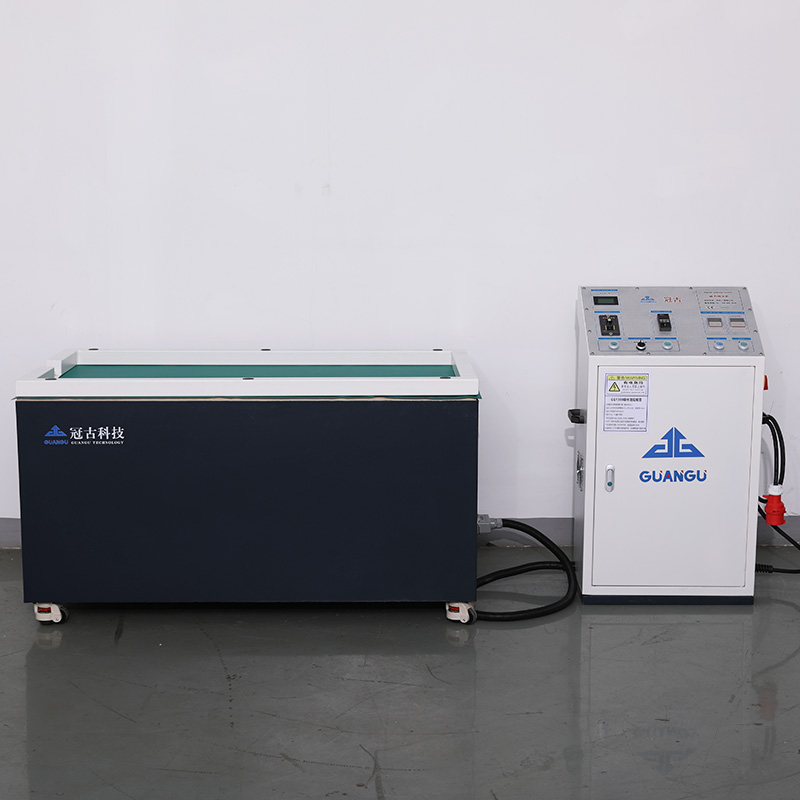
In the manufacturing fields of precision hardware, electronic components, and medical devices, "surface treatment" is always a crucial and unavoidable step—burrs, oxide layers, oil stains, scratches… these imperfections not only affect the appearance of products but can also reduce assembly precision or cause functional malfunctions. Traditional polishing methods rely on manual labor or inefficient equipment, often facing the pain points of being time-consuming, inconsistent, and costly. Now, a magnetic polishing machine is revolutionizing efficiency, accelerating the industry with a "basket of workpieces in just 10 minutes" process.
The Pain Points of Traditional Polishing: A Dilemma Between Time and Quality
Before encountering magnetic polishing machines, Manager Zhang of an auto parts factory was plagued by headaches regarding the polishing process: "We process 500 kilograms of copper connectors daily. A traditional vibratory polishing machine takes two hours to run one basket (about 20 kilograms), and manual sanding is even slower, often resulting in over-polishing or under-polishing. When deadlines are tight, the entire production line has to work overtime until late at night."
This is not an isolated case. The bottlenecks of traditional polishing methods are obvious:
• Low efficiency ceiling: Manual polishing relies on experience, taking 5-10 minutes per piece; vibratory/centrifugal polishing is limited by abrasive friction efficiency, resulting in long batch processing cycles;
• Unstable quality: Uneven manual operation force, and vibratory polishing easily leads to blind spots and residue due to workpiece accumulation;
• High overall cost: Labor costs exceed 40%, and rework of defective products further increases losses.
Magnetic MocoaPolishing Machine: The "Black Technology" Logic Behind 10 Minutes
The speed of the magnetic polishing machine stems from its revolutionary working principle—using a magnetic field as an "invisible hand" to drive agglomerates for precise work. Unlike the mechanical collisions of traditional equipment, it uses a high-frequency alternating magnetic field to create a spiral vortex of abrasive-containing magnetic current on the workpiece surface, achieving "flexible grinding." This design allows for a qualitative leap in efficiency and quality:
1. Full-Dimensional Coverage, No Dead Angles
The magnetic field can penetrate complex structures such as workpiece crevices, blind holes, and threads. The abrasive, carried by the magnetic current, envelops the workpiece 360°, even uniformly polishing "dead corners" that are difficult for traditional equipment to reach. A 20kg basket of irregularly shaped hardware (such as multi-hole molds and slender shafts) can be completely surface-treated in one go without needing to be turned over or divided into batches.
2. Intelligent Speed Control, Time Compressed to 10 Minutes
By adjusting the magnetic field strength and magnetic current flow rate, the equipment can precisely match the polishing requirements of different workpieces. Taking common stainless steel stamping parts as an example: Loading (2 minutes) → Program start (automatic timing) → Unloading (1 minute), the entire process takes only 10 minutes, increasing efficiency by 12 times compared to vibratory polishing and over 30 times compared to manual grinding.
3. Low loss, high consistency, and a sharp increase in yield
The contact pressure between the magnetic current and the workpiece is uniform and controllable (adjustable to 0.1-0.5N), avoiding dimensional deviations caused by over-polishing; simultaneously, the abrasive circulation and filtration system continuously recovers effective particles, reducing repeated friction. Actual test data from an electronics factory shows that after using a magnetic polishing machine, the surface roughness of the workpiece decreased from Ra1.6μm to Ra0.2μm, and the defect rate decreased from 8% to 0.5%.
A 10-minute efficiency revolution: How to reshape enterprise competitiveness?
For manufacturing enterprises, "processing one basket in 10 minutes" is not just about reducing time, but also about comprehensive optimization of production capacity, cost, and quality control:
• Increased Production Capacity: A single machine can process over 1 ton per day (based on 8 hours), equivalent to the workload of 5-8 skilled workers, helping enterprises take on larger orders;
• Dramatically Reduced Costs: Eliminates over 70% of polishing labor, and reduces abrasive consumption by 60% (traditional equipment consumes 200kg of abrasive per month, while magnetic polishing machines only require 80kg);
• Standardized Quality Control: Procedural operations eliminate human error, achieving product consistency of over 99%, and significantly improving customer acceptance rates.
From "Usable" to "Effective": The Adaptability of Magnetic Polishing Machines
Some may ask, "It's fast, but can it handle our complex workpieces?" In fact, the flexibility of magnetic polishing machines far exceeds expectations:
• Wide Material Compatibility: It can process stainless steel, copper, aluminum, zinc alloys, and even ceramics and glass;
• Unrestricted Shapes: From tiny screws with a diameter of 0.5mm to irregularly shaped flanges of 200mm, from flat parts to precision parts with deep holes and bends, all can be processed in one go;
• Diverse Functions: In addition to polishing, it simultaneously achieves deburring, oxide layer removal, and oil Mocoacleaning, reducing process connection time.
Conclusion: 10 Minutes – Efficiency, and the Future
In the fiercely competitive manufacturing industry where "the fast eat the slow," magnetic polishing machines, with their ability to process a basket of workpieces in 10 minutes, offer businesses a breakthrough solution. It's not just a piece of equipment, but a practice of an "efficiency revolution"—transforming the tedious surface treatment process from a "time-consuming and labor-intensive bottleneck" into an "engine for enhanced competitiveness."
If you're also troubled by low polishing efficiency, high costs, and inconsistent quality, consider giving a magnetic polishing machine a chance. Ten minutes could be the starting point for upgrading your production line.
Tip: When choosing a magnetic polishing machine, it's recommended to pay attention to magnetic field uniformity, the abrasive circulation system, and program adjustability. These are the core configurations that ensure "high efficiency in 10 minutes + stable quality."